
Albany County Deed Records and What They Show
Four systems share the work in Albany County. PROS handles assessment rolls. The County Clerk SearchIQS index covers recorded documents. Municipal offices keep local tax data, and the county GIS viewer maps parcels. Match your question to the right source. Then check each result's date, municipality and parcel key before comparing anything. A current roll field can lag a newly recorded deed. A mapped line is a reference, not a survey.
| Deed Type | What It Does | Common Use |
|---|---|---|
| Warranty deed | Albany County record detail | Albany County record detail |
| Quitclaim deed | Albany County record detail | Albany County record detail |
| Grant / special warranty | Albany County record detail | Albany County record detail |
| Trustee / executor deed | Albany County record detail | Albany County record detail |
| Tax deed | Albany County record detail | Albany County record detail |
No single database holds everything. Albany County spreads property records across PROS, the County Clerk's SearchIQS index, municipal assessment and tax offices, and the county GIS viewer. Knowing which office keeps what saves time. Compare only records that share the same parcel key and municipality. A roll entry may lag a newly recorded deed. A mapped boundary deserves skepticism, since it is never a surveyed line.
The Albany County Grantor-Grantee Index
PROS, the County Clerk SearchIQS index, municipal assessment and tax offices, and the county GIS viewer each hold a piece of Albany County property records. Pick the tool that matches your key. Names, addresses and parcel numbers open different doors. Before comparing anything, note the date, the municipality and the parcel key on each result. Discrepancies are normal. A current roll field can differ from a newly recorded deed. A mapped line is not a surveyed boundary.
- Open the relevant official Albany County portal and search with the most exact key available.
- Open the parcel or document result and save its owner, SBL, date and recording reference.
- Cross-check the same property in the next official record system.
- Compare dates and jurisdictions, then note any conflict that needs custodian review.
- Grantor
- Albany County record detail
- Grantee
- Albany County record detail
- Chain of title
- Albany County record detail
- Book/Page vs Instrument #
- Albany County record detail
Getting a Copy of a Albany County Deed
Where does a deed search in Albany County begin? It depends on the question. Recorded documents sit in the County Clerk's SearchIQS index, assessment data in PROS, local taxes with municipal offices, and parcel shapes in the county GIS viewer. Check the date and parcel key on every result. Otherwise you may compare a stale roll field against a fresh deed, or read a mapped line as a survey it never was.
Recorded, not guaranteed. Albany County record detail
Search Albany County Deed Records From 1980 Forward
SearchIQS is the County Clerk's working index for Albany County deed records from 1980 forward. Search the current owner as grantee first. Narrow by date or town when the name is common. Read the description before opening an image. Results can carry book and page, instrument number, parties, recording date and document group. Remember that a deed transfers interest. A mortgage, satisfaction, lien or lis pendens records a different event entirely, not a new owner.
The Albany SearchIQS entry screen is the county-linked access point. 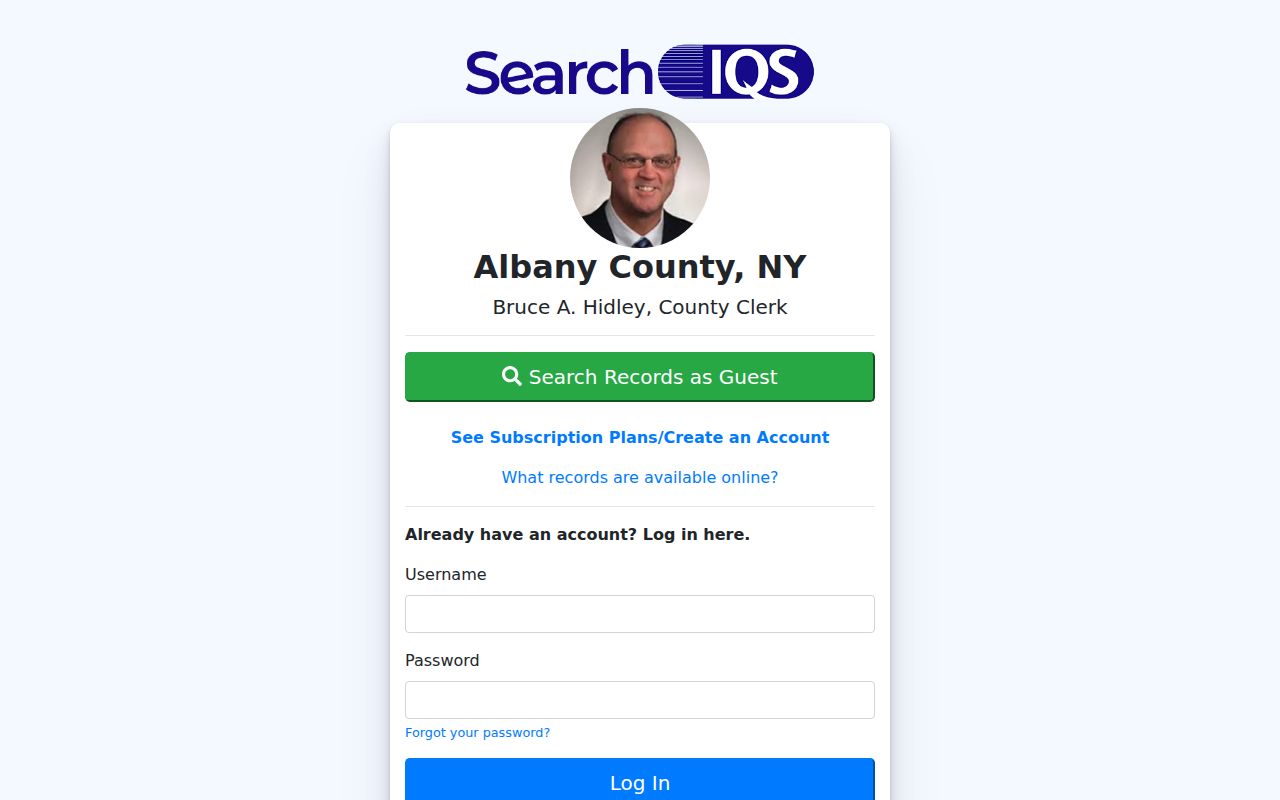 A portal result is an index lead, so retain the recording reference and verify the image or custodian copy.
Cross the 1979 Albany County Historical Index Boundary
The county's published availability sheet splits its holdings in two. Online deed and mortgage material starts in 1980. Everything older sits in historical index books. Deed indexes reach to 1922 and record books begin in 1908, while grantor, corporate grantor and mortgage index runs start in various years, including 1940 and 1948 dates named in the sheet. Some old volumes are indexes only. Use the entry's book and page to request the document when no image appears.
The Hall of Records holds deeds reaching to 1681. Its research application asks for names and approximate dates. The fee is $20 per hour with a one-hour minimum, payable even when nothing turns up. Certified copies cost $4. Use this route when an address is missing from the party index, when old handwriting defeats you, or when a chain predates the online books.
Read Albany County Grantor and Grantee Roles in Sequence
Start with the roles. The grantor conveys; the grantee receives. To walk a chain backward, begin with the newest deed naming today's grantee. Read its grantor, then search that name as an earlier grantee. Repeat while matching the legal description, town, book and page. Quitclaim wording passes along whatever interest the grantor holds, with no promise of good title. Estate transfers, fiduciary deeds and tax deeds reflect their own transaction contexts.
Addresses can vanish or renumber. The legal description controls anyway. Lot and block, subdivision names, metes-and-bounds calls and earlier town names keep the chain on the right land, far better than directories or tax rolls, which hint at occupancy but can lag the newest recorded deed. Directories cannot replace Albany County deed records.
Protect and Verify an Albany County Deed Trail
The County Clerk's Fraud Alert service monitors up to ten names for deed or mortgage activity. It sends notice only. It stops no recording. It is not a title policy, either. Save images, index details and retrieval dates as you go, since current deeds and mortgages also receive archival microfilm backup while digitization work continues.
An Albany County deed index shows what the clerk recorded and nothing more. Interests can go unrecorded, instruments forged, estates unresolved, and mapped lines off the mark. When legal reliance matters, get the official copy. Then use a title professional or attorney. For a physical line dispute, rely on a licensed surveyor and the recorded description, never the GIS outline.
Use Albany County Deed References With Maps and Archives
Grab that deed book and page number and it becomes a bridge. The reference ties a County Clerk index entry to a GIS map popup. Further back, it reaches archive material held at the Hall of Records. Copy it exactly. Then lay the legal description against the current PrintKey and see whether they agree. Street names shift over the decades. When one fails, search the subdivision, the lot, an adjoining owner of record, or the metes-and-bounds calls. Finding aids and oversized scanning resources at the archives earn their keep. They handle plats and survey sheets too large for a normal online image.
Albany County property records never hold deeds alone. Mortgages, assignments, satisfactions, judgments, and lis pendens sit in the same books. Read the parties and the instrument type before trusting what an entry means. A satisfaction releases a mortgage without moving ownership. A lis pendens flags litigation touching the parcel, yet it is not a deed. Keep every instrument in date order and note the gaps. The chain you build stays transparent. The legal assurance still belongs to a full title examination.