
What Albany County Property Tax Records Show
Albany County splits its property data across several doors. PROS handles countywide parcels. The County Clerk SearchIQS index covers recorded documents. Municipal assessment and tax offices keep the local rolls and bills, while the county GIS viewer adds the map. Read the date, municipality, parcel key and source before comparing results; a current roll field can differ from a newly recorded deed, and a mapped line is a reference rather than a surveyed boundary.
| Field | What It Shows | Where |
|---|---|---|
| Assessed value | Albany County record detail | local assessor |
| Market / appraised value | Albany County record detail | local assessor |
| Exemptions | Albany County record detail | local assessor |
| Tax bill & status | Albany County record detail | municipal treasurer |
| Taxing districts | Albany County record detail | municipal treasurer |
No single database holds everything in Albany County. Parcels live in PROS. Recorded instruments sit in the County Clerk SearchIQS index. Municipal assessment and tax offices manage their own rolls and bills, and the county GIS viewer supplies mapped context for any parcel. Check the date, the municipality, the parcel key and the source on every result before lining records up, since a roll field can trail a fresh deed and a mapped line is not a surveyed boundary.
Looking Up a Albany County Tax Bill
Property tax questions in Albany County rarely have one home. The countywide PROS system tracks parcels. The County Clerk SearchIQS index indexes recorded documents. Municipal assessment and tax offices hold the rolls and bills, and the county GIS viewer places each parcel on a map. Before comparing anything, note the date, municipality, parcel key and source, because a current roll entry can disagree with a newly recorded deed and a map line is only a reference.
- Open the relevant official Albany County portal and search with the most exact key available. by address or parcel]
- Open the parcel or document result and save its owner, SBL, date and recording reference.
- Cross-check the same property in the next official record system.
- Compare dates and jurisdictions, then note any conflict that needs custodian review.
- Assessed value
- Albany County record detail
- Mill rate / levy
- Albany County record detail
- Homestead exemption
- Albany County record detail
- Tax lien
- Albany County record detail
Appealing a Albany County Assessment
Albany County spreads its property records across several systems. PROS holds recorded documents. The County Clerk SearchIQS index covers filings. Municipal assessment and tax offices maintain the rolls. A county GIS viewer maps parcels alongside all of it.
Check the date, municipality, and parcel key on each result. Also note the source. Comparing records only works when you know where each one came from.
Note: A current roll field can differ from a newly recorded deed. A mapped line is a reference, not a surveyed boundary.
Appeal window. Albany County record detail with the Board of Assessment Review; missing the window means waiting for the next cycle.]
Decode Albany County Property Tax Record Fields
One assessment record can pack a great deal onto a single line: owner, location, tax-map parcel, account, SWIS code, property class, deed book, land assessment, total assessment, exemptions, taxable values and full-market value. None of these fields mean the same thing. Land assessment covers the site alone. Total assessment folds in improvements. Taxable values shift with the exemptions applied to a stated levy, while full-market value is an assessor's estimate tied to the roll and the local uniform percentage.
Save the municipality and roll year every time. Albany County contains many assessing and collecting units. The countywide PROS parcel is the common starting point, yet the bill source depends on jurisdiction. A mailing address only shows where notices go, and it may differ from the situs. The assessment owner can also trail a newly recorded deed, since the county publishes no fixed update lag.
Read the City of Albany 2026 Grievance Route
The City of Albany publishes a 2026 assessment calendar and a separate grievance page. The route runs through form RP-524. That form asks for identifying property information and supporting evidence. Comparable sales carry the most weight when they match the property in class, location, size, condition and valuation date, and a feeling that a tax amount is too high does not by itself prove the underlying assessment is unequal or excessive.
The official grievance instructions show filing channels and required information. 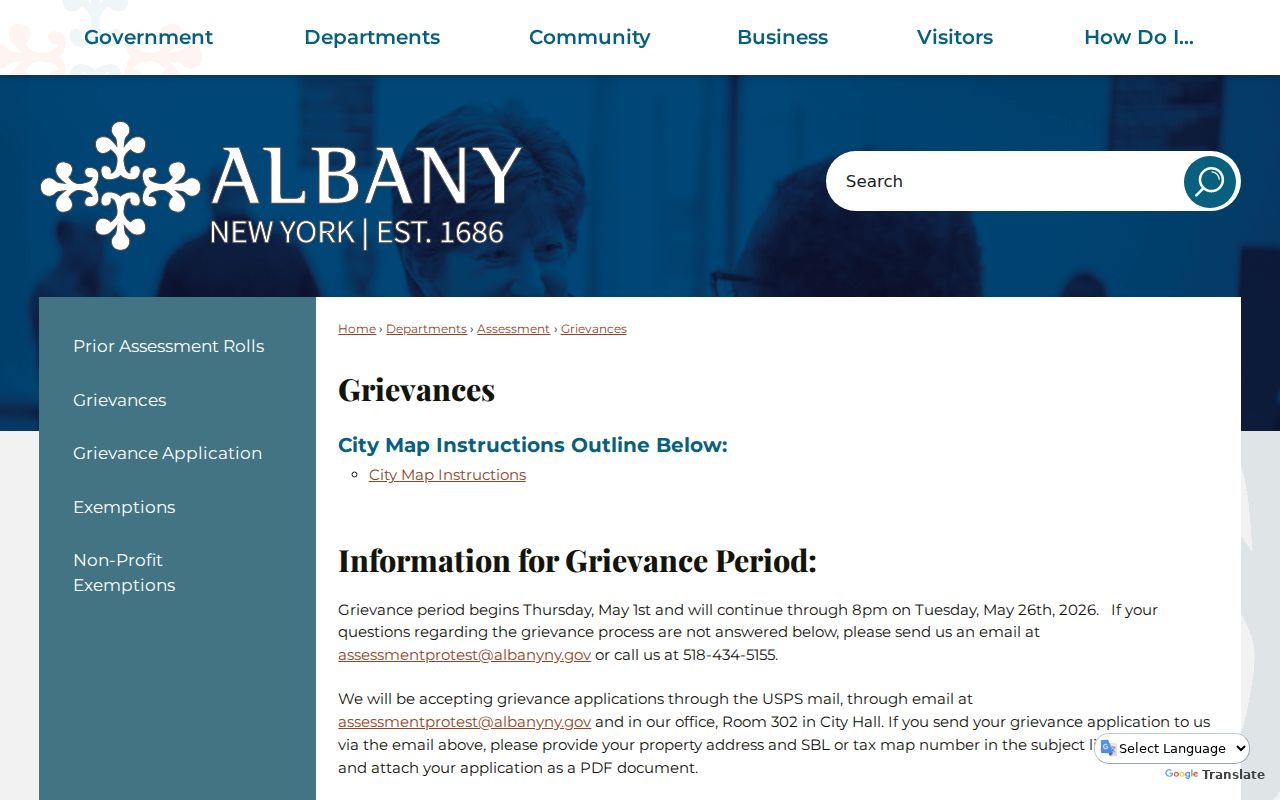 Owners elsewhere in Albany County must follow their own assessing unit’s calendar rather than assuming the city dates apply countywide.
Separate Albany County Tax Bills From Assessment Values
A tax bill multiplies taxable assessment by levy rates. Charges come from the city, school district or special district involved. Payment status is a collector matter. Interest and delinquency live there too. The assessor, by contrast, explains the roll value and any exemptions. The City of Albany Treasurer provides bill, receipt and payment access. County delinquent-tax and auction materials cover later enforcement and in-rem context. An auction notice should never be read as a market listing.
Two dates explain most timing puzzles. March 1 is the taxable-status date and July 1 the valuation date. That is why the roll, the deed and the property's current condition can describe different moments. Record each date before comparing years. An exemption can cut one taxable column without touching total assessment. A recorded sale may not be arm's-length. Neither the bill nor a single sale price adds up to an appraisal.
Use Albany County Tax Records as a Dated Evidence Set
Start with the exact SBL in PROS. Confirm the municipality. Then open the collector's bill for that parcel. Line up owner, situs, roll year, total assessment, exemption codes and payment status side by side. A recent deed naming a different grantee deserves both dates. Ask the assessor when the ownership field will update. A missing payment calls for the treasurer's receipt. Direct confirmation also beats a cached search result.
Used this way, property tax records support budgeting, exemption review and assessment challenges. They cannot establish clear title, expose every lien or predict a sale price. SearchIQS supplies recorded instruments and the GIS map supplies context, but only a licensed appraiser offers a current opinion of market value. Keeping those roles straight stops a tax-field label from carrying more weight than the record supports.
Research Albany County Delinquency Without Assuming a Sale
Delinquency lists and 2026 auction packets from Albany County describe tax-sale and in-rem administration. They also explain how tax allocation works before and after a bid. Appearance in a delinquency list or meeting packet is a dated enforcement fact. It is not proof that title has moved. Before drawing conclusions, confirm the tax year, municipality, and amount. Check redemption or payment status too. Also confirm any later deed with the office that holds those records.
An owner doing diligence should keep the current tax bill, payment receipt, and parcel number. Then search the Clerk's deed index for tax liens or deeds touching the parcel. An auction award or arrears total is never market value. Interest, fees, exemptions, and multiple levies can shift the balance while leaving the assessment untouched. A wrong assessment belongs on the local grievance calendar. A missing payment belongs with the collector. Ownership after enforcement belongs with the recorded deed itself.
One last check: compare the exemption code against the taxable column in the levy under review. STAR, veteran, senior, and disability relief can move those columns in different ways. Eligibility rules rest with the administering assessor. Keep the official notice and its filing date when you request a review.